

Choose the wrong automatic gate and you’ll waste thousands on a system that frustrates you daily. Choose the right one and you’ll get years of reliable security and convenience that adds real value to your property.
This guide breaks down every major type of automatic gate – from sliding gates and swing gates to boom gates and specialised systems. You’ll learn how each gate system works, where it shines, and what it costs.
Key Takeaways
Main types of automatic gates:
- Sliding gates: Move horizontally along fence line, work on any slope, need fence line space
- Swing gates: Pivot like doors, need front clearance, work best on flat driveways
- Telescopic gates: Stack multiple panels, use 1/3 the fence line space of standard sliders
- Boom gates: Fast lifting barriers for high-traffic commercial use and car parks
- Cantilever gates: Slide without ground track, ideal for uneven terrain and drainage issues
- Vertical lift gates: Raise straight up, maximum security for industrial applications
- Bi folding gates: Fold panels for tight spaces, use half the space of standard sliders
Critical factors for choosing:
- Driveway slope determines which gate types will work (steep slopes require sliding, telescopic, cantilever, or bi folding)
- Available space dictates whether you need swing arc clearance or fence line space
- Usage frequency determines motor grade (residential 10-30 cycles/day vs. commercial 100-500+ cycles/day)
- Budget for quality motor and construction over decorative features
Typical costs:
- Entry level swing gates: $3,500-5,500
- Mid-range sliding gates: $4,500-9,000
- Premium telescopic/cantilever: $8,000-20,000+
- Industrial vertical lift: $15,000-25,000+
What Are Automatic Gates?
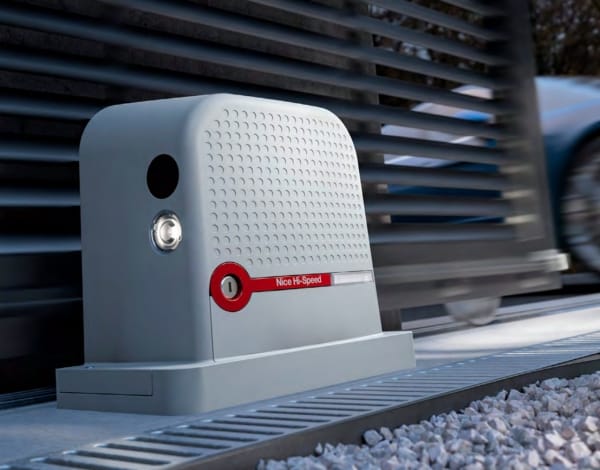
An automatic gate opens and closes with electric motors instead of manual effort. The motor connects to a control unit that manages opening sequences, safety features, and access permissions. You control it with a remote control, keypad, smartphone app, or intercom system.
No more getting out of your car and hauling the gate open in a downpour during storm season. Simply open it with the push of a button from the comfort of your car.
What You Need to Assess Before You Choose a Gate
Before you start comparing types of automatic gates, work out these factors. They’ll quickly narrow down which automatic gate systems will actually work for your property.
Your Available Space
Swing gates require room to swing open – basically clearance equal to the gate’s width. Automatic sliding gates need that same space, but along your fence line instead of in front. If you’re dealing with limited space in both directions, telescopic gate or bi folding gates might be your only options.
Your Driveway Slope
Got a steep driveway? You’re looking at sliding gates, telescopic gates, cantilever gates, or bi folding gates (with rising hinges for steeper slopes). Traditional swing gates will scrape the ground or refuse to close properly – don’t bother trying to make them work on steep slopes.
Flat or gently sloping driveway? Any gate type will work fine as long as there’s enough space.
Gate Weight and Size
Gate weight and size affect which motor you need. A 4-metre steel gate weighs 250-350kg and demands a robust motor. Aluminium gates weigh 120-180kg and work with smaller electric motors. Underspecified motors fail prematurely so this is critical to get right. When choosing a gate opener/motor make sure you check the weight ranges it’s designed for and if it will be enough for the weight and size or your gate.
How Often You’ll Use It
Match your motor to your actual usage or you’ll be replacing it sooner than you’d like.
Residential automatic gates typically cycle 10-30 times daily – morning commute, kids coming home, evening deliveries. Standard residential motors handle this load easily with proper cooling periods between cycles.
Commercial properties are a different story. A shopping centre car park might cycle 200-500 times daily. Office complexes with multiple tenants can hit 300+ cycles during peak hours. These environments need commercial-grade motors with continuous duty ratings, better heat dissipation, and reinforced components.
Power Supply
Most electric gates run on mains electricity which is a reliable and virtually unlimited capacity. But if power isn’t already near your gate, running cables gets expensive fast.
Solar powered gates with battery storage works brilliantly in Melbourne and eliminates trenching costs entirely. It’s particularly popular for rural and farming properties where gates might sit 50-200+ metres from the nearest power source.
Worth thinking about backup power too. Nothing worse than a blackout leaving you stuck on the wrong side of your gate. Battery backup keeps everything running during outages – pretty critical if you can’t afford downtime.
Access Control

How do you want to open your gate? Basic setups use remote control devices. Multiple users might need keypads with PIN codes. Want to screen visitors? Add an intercom. Commercial properties often use card readers or smartphone apps. High-security sites might go for biometrics or license plate recognition.
Access control systems let you manage who gets in and when. Pick your access method based on how many people need entry and how tight your security needs to be.
Your Budget and Where to Spend It
If budget’s tight, spend your money where it matters most: on a quality motor and quality construction. These are what determine whether your gate lasts 15+ years or needs replacement after 5.
Where you can save without compromising longevity:
- Skip decorative elements and ornamental details initially – you can add these later
- Go with simpler materials like basic steel or aluminium instead of custom designs
- Choose standard colours (eg. black) rather than custom powder coating
- Start with basic access control (remote only) and add keypads or intercoms down the track
Where you shouldn’t compromise:
- Motor quality and proper sizing for your gate’s weight
- Safety features (photocells, obstacle detection)
- Professional installation with proper foundations
Typical costs by gate type:
- Basic swing gates: $3,500-5,500
- Sliding gates: $4,500-9,000
- Telescopic and bi folding: $6,000-12,000
- Cantilever: $12,000-20,000+
- Vertical lift: $15,000-25,000+
A well-built basic system beats a system that has all the bells and whistles but comes with a cheap motor/construction every time.
The Main Types of Automatic Gates Explained
Sliding Gates

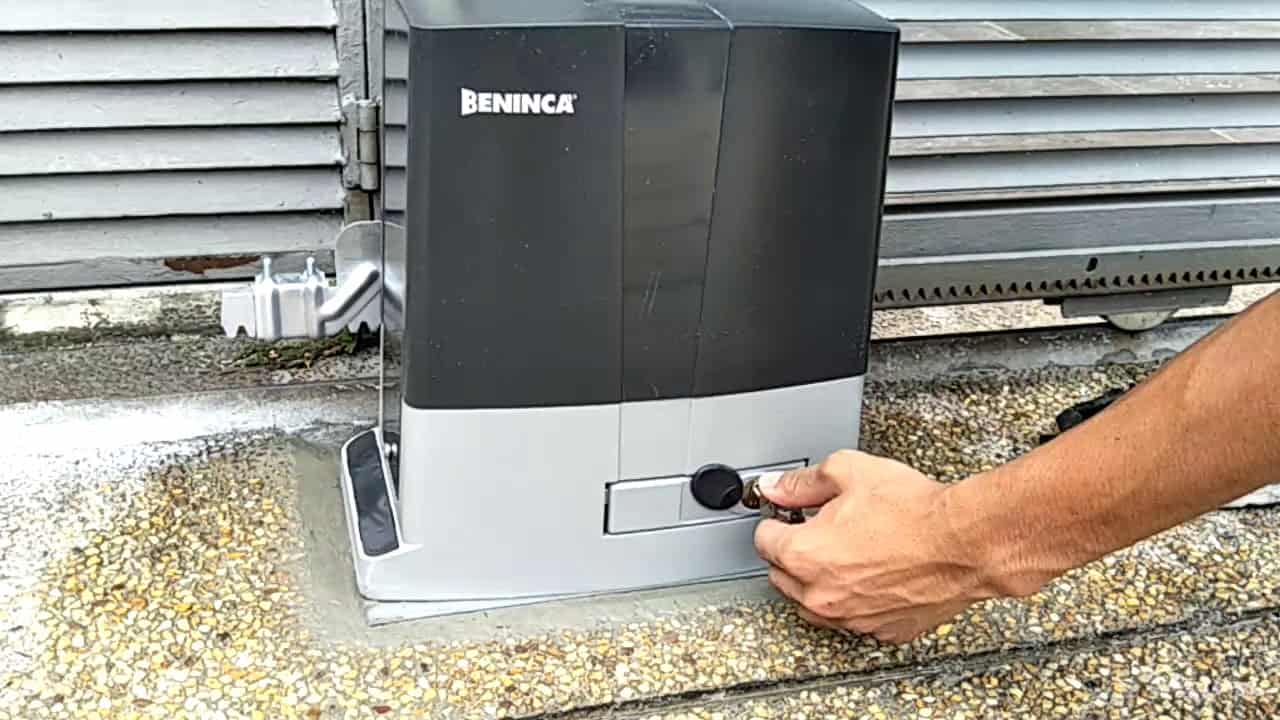
Sliding gates roll horizontally along your fence line on a ground track. A motor near the fence drives the whole thing using a rack-and-pinion setup (basically interlocking gears). Automatic sliding gates deliver smooth and efficient operation for both residential and commercial properties.
Why choose them:
- Work on any slope – steep driveways are no problem
- Don’t need clearance in front of the gate
- Handle wide openings (6-10 metres) efficiently
- More secure than swing gates (nothing to pry open at the hinges)
- Hold up well in wind when in a closed position
- Great for properties with limited space in front of the entrance
The downsides:
- You need fence line space equal to the gate width plus about 400mm for the motor and opening mechanisms
- The ground track collects leaves and debris – you’ll need to clean it occasionally
- Cost more upfront than basic swing gates
- Installation takes a few days because of concrete work
- Require occasional maintenance to keep the track clear
- Residential sliding gates typically handle 300-600kg. Commercial versions go 600-1000kg and gates open faster without overheating under heavy use.
Cost:
- $4,500-9,000 for residential properties
- $9,000-15,000+ for commercial applications
Swing Gates
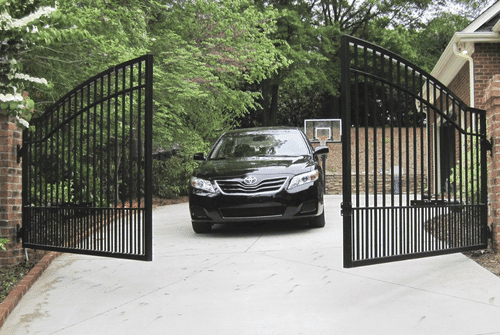
Swing gates work like any door – they pivot on hinges from a pivot point and swing in an arc. You can get single gates (one panel) or double gates (two panels that meet in the middle). Automatic swing gates are popular for both residential and commercial applications.
Motor options:
- Articulated arm motors sit visibly on a post beside your gate. Most popular for homes because they’re straightforward and accessible for maintenance.
- Underground motors hide beneath the ground – only a small cover plate shows. Great for prestige properties where you want invisible automation.
- Ram-style motors use a straight hydraulic or electromechanical ram. Compact and powerful for heavier metal gates.
Why choose them:
- Classic look suits most homes, especially heritage properties
- Work great on flat or gently sloping driveways with ample driveway space
- Don’t eat up fence line space. Ideal when you’ve got limited room along your fence, eg. retaining walls.
- Usually cost less than automatic sliding gates
- Easy to operate manually if the power’s out
- Provide a sleek and modern appearance with underground motor options
- If you’re wanting to convert an existing driveway gate into an automatic gate, it’s probably a swing gate, in which case a swing gate opener is the most effective option.
The downsides:
- Swing gates require clear space for the swing arc (equal to gate width)
- Won’t work on steep slopes
- Wind can mess with them
- Limited to about 7 metres maximum width with double swing gates
- Gates open slower than sliding gates
Go with single leaf for openings up to 3.5-4 metres. Beyond that, double leaf makes more sense – two lighter panels with two motors instead of one massive heavy panel that needs an industrial-strength setup.
Cost: $3,500-8,000 for residential areas; $8,000-15,000+ for heavy-duty commercial properties
Telescopic Gates
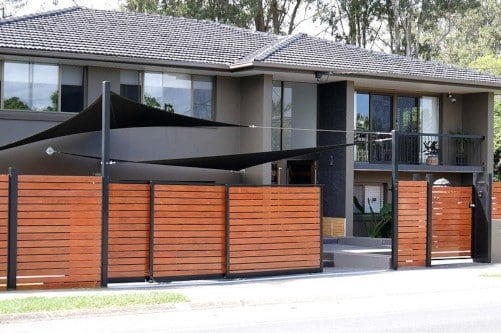
Telescopic gate systems use multiple panels that overlap when closed and stack when opening. A typical three-section telescopic gate spanning 6 metres only needs about 2.5 metres of fence line space – an efficient solution for properties with limited space.
Think of it like those old telescoping antennas. The front sections slide over the rear sections as the gate’s movement progresses. The motor pulls the front section and mechanical connections make the other sections follow along.
Why choose them:
- Solve the problem when you’ve got a wide entrance but not enough fence line space for a standard slider
- Need only about a third of the fence line space compared to standard sliding gates
- Handle really wide openings (8-10 metres)
- Work on slopes just like regular automatic sliding gates
- Modern, professional look suits commercial properties
- Great for corner properties where space is tight
- Perfect for properties with limited available space in all directions
The downsides:
- Most expensive residential option
- More complex mechanism with multiple wheel sets and multiple panels
- Take longer to install (3-5 days) and need precision during the installation process
- You’ll want experienced techs for occasional maintenance
Cost: $8,000-20,000+
Boom Gates (Barrier Arms)
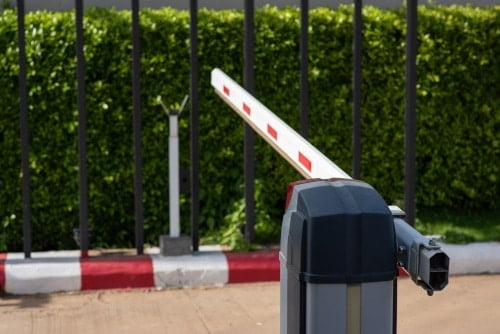
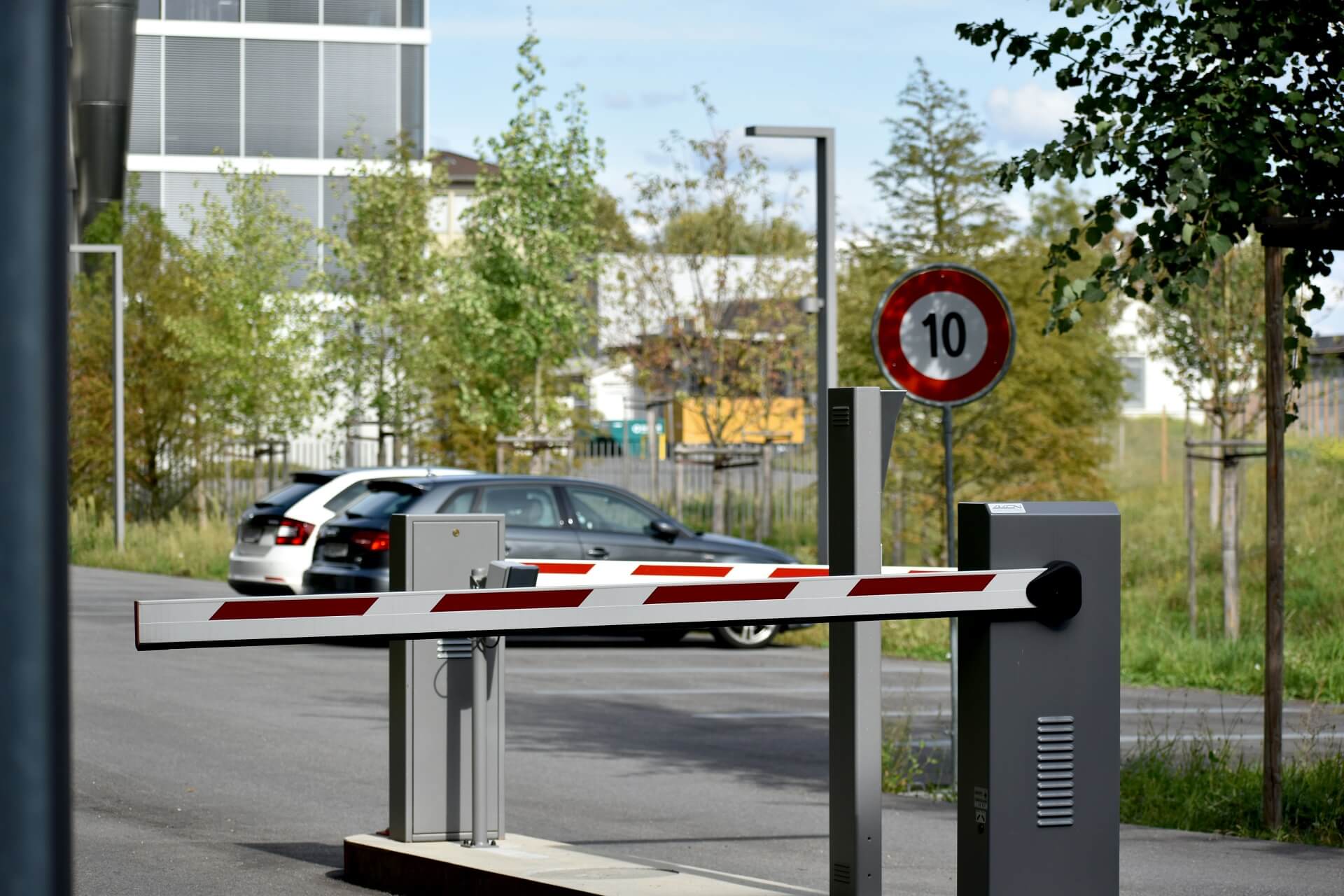
Boom gates use a pivoting arm that lifts vertically. Think car park barriers. They’re fast – 2 to 6 seconds from closed to open, making them an effective option for high-traffic areas.
You’ll see standard versions (3-6 metre arms), high-speed models (under 2 seconds for busy facilities), and heavy-duty industrial versions with reinforced arms that can take a beating.
Why choose them:
- Extremely fast operation (2-6 seconds) keeps traffic flowing in car parks
- Built to handle thousands of daily cycles without breaking down
- Perfect for high-traffic commercial use and security checkpoints
- Clear visual indicator of whether access is granted
- Easy to integrate with ticketing and payment systems
- Take up minimal space
- Fast, cost effective access control solution for parking facilities
Downsides:
- Not really secure – people can duck under, drivers can force through
- Arms can get damaged by impatient drivers
- Don’t provide any privacy screening
- Industrial look doesn’t suit residential properties
Cost: $4,000-10,000
Cantilever Gates

Cantilever gates slide horizontally but without a ground track. The entire gate hangs from a wheeled carriage running along an overhead beam – a sophisticated gate automation solution.
The trick is a substantial rear section behind your fence line that carries wheels running along a support beam. This counterbalances the gate’s weight and lets it slide smoothly without anything touching the ground, providing smooth operation even on uneven terrain.
Why choose them:
- Nothing crosses your driveway at ground level – perfect when ground track installation isn’t practical
- Handle uneven ground and poor conditions that would make standard tracks problematic
- No track to clean, making them a low maintenance option
- Don’t interfere with drainage or heavy ground traffic (forklifts, trolleys)
- Meet hygiene requirements for sensitive facilities like medical or food processing
- Ideal for sites with drainage issues or uneven terrain
- Excellent for properties with limited space where ground tracks won’t work
Downsides:
- Cost 30-50% more than standard sliding gates
- Need an extremely robust support structure on the side
- Must be professionally installed – DIY or poor installation leads to failures
- That rear overhang needs significant space behind your fence line
Cost: $12,000-20,000+
Vertical Lift Gates
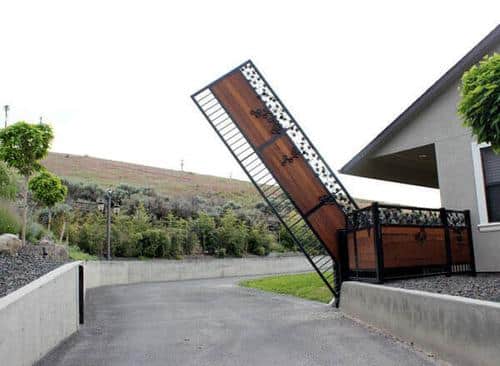
Vertical lift gates go straight up like a roller door but made from solid panels. These are specialised types of automatic gates for industrial and high-security applications.
The gate panel lifts using a counterweight or spring mechanism. Electric motors power the lift while the counterweight reduces the power needed. When fully open, vertical lift gates sit overhead and completely clear the entrance.
Why choose them:
- Zero horizontal space needed – perfect for industrial facilities where horizontal space isn’t available
- Solid barrier that’s extremely secure for high-security installations
- Very difficult to force open or ram through
- Completely clear entrance when open
- Handle very wide openings
- Best for maximum security requirements
- Ideal for properties with limited horizontal space
Downsides:
- Need vertical clearance above the entrance
- More expensive than sliding or swing gates
- Complex installation requires structural support
- Higher maintenance than simpler gate types
Cost: $15,000-25,000+
Bi Folding Gates
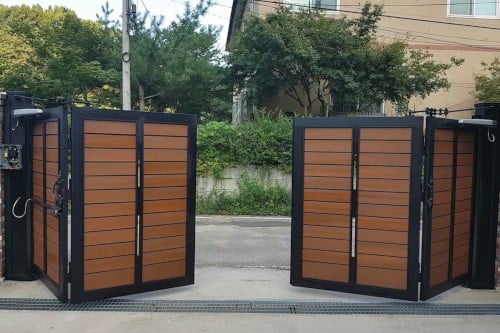
Bi folding gates use two or more hinged panels. As the gate opens, it folds back on itself with multiple panels stacking alongside each other – like a folding door. Bi folding gate systems offer an efficient solution for tight spaces.
The motor pulls the front panel along a track. Hinges force the other panels to fold as everything moves. When fully open, the stacked panels take up roughly half the space of a standard automatic sliding gate.
Why choose them:
- Maximum space efficiency when you’re tight on space in all directions (about 50% of standard sliding requirements)
- Modern aesthetic works with contemporary properties
- Gates open faster than standard sliding gates
- Handle moderate slopes
- Solve problems where both swing arc space and fence line space are limited
Downsides:
- More expensive than standard swing or sliding gates
- More mechanically complex than standard gates
- More maintenance points with all those hinges and wheel sets
- Less common, which can affect finding service
- Not suitable for very heavy designs
Cost: $6,000-12,000
Safety Features Worth Caring About
Modern automatic gates often come loaded with safety features. These aren’t marketing fluff – they’re what keeps your gate from hurting someone or getting damaged. But some safety features are more important than others.
Essential Safety Features
- Photocells throw invisible beams across your gate opening. Something breaks the beam while the gate’s closing? It stops and reverses immediately. Most good setups use multiple pairs at different heights.
- Obstacle detection means the motor senses when it hits unexpected resistance. Hit something? The gate stops and reverses before it causes damage.
- Emergency releases let you disconnect the motor and operate the gate manually during power failures or emergencies. You definitely want this.
Optional Safety Features
- Soft start/stop means your gate accelerates and decelerates smoothly instead of jerking around. Easier on the mechanism, safer for anyone nearby, and contributes to smooth operation.
- Auto-close timers shut your gate automatically after a set time. Forgot to close it? The gate hasn’t. Handy for security.
- Warning signals like flashing lights and beeps – let people know the gate’s about to move. More important for commercial sites with lots of foot traffic, but useful anywhere.
- Battery backup keeps everything running during power outages. Critical if you can’t afford to be locked in or out.
- Loop detectors sense vehicles in the driveway and prevent the gate from closing on them.
When you’re comparing quotes for installing automatic gates, check what safety features are actually included.
Matching Your Situation to the Right Gate
Steep driveway? Automatic sliding gate. That’s really your only reliable option. Telescopic gates work too if you’re short on fence line space.
Wide opening but limited fence line space? Telescopic gate solves this specific problem. A 6-metre opening needs only 2.5 metres of fence line versus 6+ metres for standard automatic sliding gates.
Want traditional looks on level ground with ample driveway space? Automatic swing gates deliver classic aesthetics. Underground motors make the gate automation invisible.
Running a high-traffic car park? Boom gates handle hundreds of cycles daily without breaking a sweat. Fast operation prevents traffic backups in car parks.
Need industrial perimeter security? Heavy-duty sliding gates or cantilever gates give you solid barriers. Go cantilever for uneven terrain or poor ground.
Coastal property? Aluminium gates or Colorbond gates handle salt air better than standard steel gates.
Heritage home? Swing gates with underground motors give you modern function with period-appropriate looks and visual appeal.
Tight budget? Single-leaf swing gate gets you in the door for the lowest cost.
Uneven terrain or drainage issues? Cantilever gates skip the ground track completely.
Constrained in every direction? Bi folding or telescopic gates depending on whether you prioritise fence line savings or proven reliability.
Gate Materials: What You Need to Know
Your gate’s material affects weight, maintenance requirements, and which motor you’ll need.
Steel gates give you maximum strength and security. But they’re the heaviest option – a 4-metre steel gate weighs 250-350kg. Metal gates need rust prevention, especially near the coast.
Aluminium gates are lightweight (120-180kg for a 4-metre gate) and don’t rust. Ideal for coastal areas. Lighter weight means smaller electric motors and less wear on components – a low maintenance choice.
Wood gates look beautiful and natural. Heritage properties love them. But wood gates need regular maintenance – sealing or staining every 1-2 years. Melbourne weather is tough on timber.
Colorbond gates are pre-painted steel with corrosion resistance. Wide range of colours to match Australian homes. Good middle ground for durability and appearance.
Composite materials combine different materials to balance weight, strength, and looks.
Heavier materials need beefier motors. That 250kg+ steel gate needs significantly more power than a 120kg aluminium gate. Factor this into your total cost.
Sliding or Swing Gate: Which One Wins?
Neither wins universally. Whether you choose a sliding or swing gate depends entirely on your property.
Go with sliding gates if:
- You’ve got a steep driveway
- Properties with limited space in front of the gate
- Wide entrance (6+ metres)
- Enhanced security is your top priority
Go with swing gates if:
- Flat or gently sloping driveway with ample driveway space
- Plenty of space in front for the swing arc
- Limited fence line space
- You want traditional aesthetics and visual appeal
The “better” option is the one that actually works with your property’s layout and matches what you care about most – appearance, security, or budget.
Making Your Decision on Your New Automatic Gate
Choosing the right automatic gate opener isn’t about going for the most expensive or most secure option. It’s about matching the gate system to your property and how you’ll actually use it.
Start with the physical stuff. Walk your entrance, measure your available space, and check your driveway slope. These hard facts eliminate gate types fast. Got a steep driveway? Manual gates and swing gates are out. Properties with limited fence line space? Standard automatic sliding won’t work.
Then think about what matters most to you. Maximum security? Solid sliding gates or vertical lift gates. Traditional appearance for a heritage property? Automatic swing gates with underground motors. Managing commercial traffic? Boom gates deliver the speed you need.
Don’t try to save a few hundred dollars by compromising on quality. A properly specified motor and professional installation save you from frustration and gate repairs down the track. The difference between a $4,500 gate that runs smoothly for 15 years and a $3,800 gate that needs motor replacement after 3 years is pretty obvious when you do the math.
Finally, think long-term. Will your usage patterns change? Is there room to modify things later if needed? A well-chosen automatic gate system should serve you reliably for decades, adding convenience, security, and value every single day.
The right type of automatic gate for your property exists. Now you’ve got the knowledge to choose it confidently.